Question: Are there any distractions in the background, foreground or edges of the frame and does it need to be moved to create a more effective image? Spyros Heniadis Video above. Successfully Using the Brenizer Method
Why Using The Brenizer Method Doesn' t Automatically Make a Great Portrait
How was your weekend? Did you get out there to take some damn photos? I've been feeling LOADS better, and my I'm bouncing back from my surgery pretty darn quickly!
This week we're doing a Critique of the Week and I look at a portrait submitted by Dor Reznik. Dor used the Brenizer method to shoot his portrait, and in the video I talk about what works and doesn't work with Dor's photo.
Using a new technique is a great way to expand your skill and knowledge, but even when using a new technique or shooting method, you still want to keep in mind your composition and what your subject is. Dor did a GREAT job with using the Brenizer method, but lost a little bit in the composition.
The composition of the photo below is amusing but very effective with the position of the lions and the truck. No negative space, cropping a bit tight at the bottom of the photo.
When taking a photo, I've started to notice the whole composition of the photo. Using the rule of thirds keeping the feet, legs etc in the area photographed. This does not always work but practice, practice more practice.
Chinese Zoo Locks Visitors in Cages, Lets Animals Roam Free ... "The Lehe Ledu Wildlife Zoo in Chongqing city, China, is giving people a chance to experience what it feels like to come face to face predators, instead of just viewing them in cages from a safe distance. Here visitors are locked up in a cage inside the back of a truck as it makes its way through the park, while the animals freely roam around, often coming close to the cage. To draw attention of the beasts, huge chunks of raw meat are tied to the bars to lure them as close as possible. The tours which were launched last month have already become a big hit among the tourists, with tickets sold out for the next three months.
“We wanted to give our visitors the thrill of being stalked and attacked by the big cats but with, of course, none of the risks,” said zoo spokeswoman Chan Liang. “The guests are warned to keep their fingers and hands inside the cage at all times because a hungry tiger wouldn't know the difference between them and breakfast.” ..."
Photographing the 80th of Patrica and family. The colours in the limousine are luminous in the dark interior of the vehicle. Not easy to photograph but definitely heaps of fun. The reflection is captured in the window. I used a Speedlite with the diffuser, this helped soften the light in such a small area.
The best option is to use external off-camera flash, but I assume from you question that you don't have the equipment.
So first try to push the ISO up as high as you are comfortable with and if this isn't enough (it probably won't be) just use your camera's flash - the light will be horrible but it's better than not having pictures at all.
Just remember the light will be bad, so try to capture exciting, funny or touching moments, don't try to take portraits with your camera's built in flash.
Update: normally I would not recommend the camera's built in flash but we have: 1. low light 2. slow lens 3. no external flash 4. bad high ISO performance 5. no long exposure (because we are in a moving, shaking, car) so there really isn't another viable alternative (except to seriously underexpose and hope you can recover something in post, but I think this is even worse than the popup flash)
This Saturday I'm going to be riding with the bride and bridesmaids to the church, and then with the happy couple from the church to a park. I'm using a Nikon D300 and I'm assuming I'll want my Tokina 12-24mm f/4. I have an SB-800 flash which I can put on my CB-Digital bracket or maybe just handhold. My main question is, what, in your opinion, is a good way to use flash in this scenario? I'm thinking about angle (bounce off ceiling, floor, front windshield, etc.), flash exposure compensation, f-stop, and ISO. I thought it might look good to try to balance the light inside with the light outside so you don't lose the scenery in the windows. I know I could get something good right now, but maybe, just maybe, with your help, I can get something spectacular!
Unless it is night time and or just plain very dark outside, I would go for high ISO and natural light (perhaps weak fill), blowing out the windows. Shots looking down the length of a limo (with people sitting all along the benches) are difficult to light evenly with a flash, even bouncing--just the couple in the back, OK, but otherwise. As for bouncing, you'd have to bounce against the opaque parts of the limo--bouncing out a window just lets the light out the window--it would be better with darkened windows. I'd aim for the part between the ceiling and side walls. Bouncing off the floor might give that horror movie effect. Some limos have mirror ceilings, which can be used to bounce, but can also throw very specular and harsh light. Also, be sure to drag the shutter if bouncing, if there are neon lights or other colored lights inside. Most brackets are just too tall for inside the limo.
As for f stop, etc.--that all depends on the situation--how much DOF you need, how your flash works, whether it is fill or main, etc.
Rolls-Royce | Bentley | Daimler Limos | Jaguars | Armstrong Siddeley and an Austin A30
Big Thanks to Maxine and Terry Sutherland (owners)
F2.8 1/200 ISO640 EF24-70mm@24mm
First Class Classics 19 March 2015
1958 Rolls-Royce Silver Wraith, was Queen Elizabeth's car during a royal tour in Australia. It was great to be able to sit in the same vehicle, the genuine smell of leather. I so enjoy photographing this elegant Rolls-Royce with so much history and character. Taking an photo was often difficult because the vehicle was so shinny, I would be in the reflection so it was defiantly a challenge but a good experience.
Showroom
22 Harris Rd
East Tamaki
Auckland 2013
Ph: 271 2552
QueenElizabeth in RR-SW. 1958
Govt. Daimler Limo – DB. Queen in Wellington – rear view of Helen Clark (left)
RRW Brisbane.
Queen on the 9 o'clock news (right)
F20 0.5 ISO100 EF24-70mm@70mm (right) Relection of myself in the photo with the tripod.
F2.8 1/80 ISO250 EF24-70mm@24mm
Relection of myself in the photo, this is something I should have notice when taking the photo. (above)
F2.8 1/1000 ISO500 EF24-70mm@28mm
Negative space in the front of the photo forms a triangle. Leading the eyes to the back left or the right of the photo, moving back to the centre.
Bridal Gowns F2.8 1/250 ISO250 24-70mm@70mm
The detail could be seen with the close up photo, elegant and beauty in both the dresses. The photo to the right shows the display complete tight frame, the image fills the area.
The Rolls-Royce fills the frame. Positive space to the top right of the photo. Big and bold looking important.
The texture is very airy. Amazing reflection, negative space in the fore ground completes the images. With the rising sun between the centre trees.
February 14, 2006 a photograph of a pond taken by Edward Steichen sold for more than $2.9 million, easily setting a world record for the highest amount a photograph has sold for at auction, Sotheby’s said (today this record has been broken a few times). The photograph, titled ”The Pond-Moonlight” and taken in Mamaroneck, Westchester County in 1904.
There are only three prints which were made under Steichen’s supervision, and are a great example of a rare vintage photograph by an artist who ha
d an influence on later 20th-century photographers. Steichen’s early painterly photographs, possibly naive to our image-soaked modern eyes, helped establish photography as an art form.
Reference: http://agnautacouture.com
Masters of Photography:
Edward Steichen
www.masters-of-photography.com
374 × 480
Search by image Edward Steichen The Maypole The leading lines of the building creates an effect of depth and height. The chains on the right seem to be going into infinity. The texture of the black and white duotone, creates a contrast, moving into negative space in the background.
Steichen’s pictorialist period ended in 1917, when he joined the United States Army and created an aerial photography unit innorthern France to gather intelligence about artillery positions and troop movements behind enemy lines. And after the war, Steichen’s lifelong interest in horticulture resulted in near-abstract images of flowers, plants and insects.
Gloria Swanson
The netting creates the texture. Tight cropping no positive or negative space.
Steichen’s portraits for Vanity Fair brought him new fame.
Reference: http://agnautacouture.com/
Yousuf Karsh (1908-2002) is one of the masters of 20th century photography. His body of work includes portraits of statesmen, artists, musicians, authors, scientists, and men and women of accomplishment. His extraordinary and unique portfolio presents the viewer with an intimate and compassionate view of humanity. Reference: http://www.karsh.org Yousuf Karsh (December 23, 1908 – July 13, 2002) was an Armenian-Canadian photographer, and one of the most famous and accomplished portrait photographers of all time.
Speaking about his Photography, he was very powerful in using studio lights.He had Photographed many famous personalities all over the world during his reign in Photography. In all his photographs there was a essence for the person he has captured which is very much visible to us. He says ” My chief joy is to photograph the great in heart, in mind, and in spirit, whether they be famous or humble”
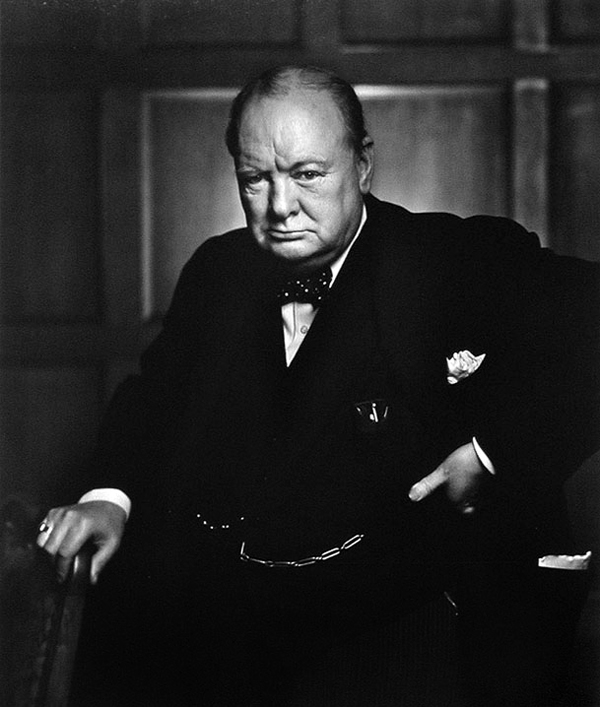
Pic 1: Winston Churchill, the smooth black texture in the suit highlight his face. Positive space, centred image.
Pic 2: Pablo Picasso, interesting how the vase is positioned, Picasso looks to be daydreaming. The negative space is on the left.
Pic 3: Ernest Hemingway, the photo cropped tightly, giving the shoulders and the face a solid look. The detail of the jerseys texture gives the photo a sailor feel. Positive space behind the head.
Pic 4: Audrey Hepburn, elegant and slender. Soft texture positioned central upper third.
Pic 1 Winston Churchill Pic 2 Pablo Picasso Pic 3 Ernest Hemingway
Positive and negative space play an important role in determining the overall composition in a work of art. By understanding positive and negative space and applying your knowledge, you can become more successful in designing your compositions.
What is Positive and Negative Space?
Simply put, positive space is best described as the areas in a work of art that are the subjects, or areas of interest. Negative space is area around the subjects, or areas of interest.
Take a look at the image below.
For example, do you see faces or a vase?
If you are seeing a vase, then you are seeing the white area as the positive space. The black areas become the negative space. If you are seeing faces, then you are seeing the black areas as the positive space, and the white area as the negative space.